Choosing between classroom navigation courses vs online navigation courses is less about which format is “best” in theory and more about how sailors learn, how quickly confidence needs to build, and how much instructor input is wanted when chartwork gets complicated.
Before we look closer at navigation classes it is worth mentioning the debate around classroom learning versus online learning extends far beyond sailing. Across education, professional training and skills development, organisations and learners continue to weigh the benefits of face-to-face teaching against the flexibility of digital platforms.
While technology has transformed access to education, the format in which learning takes place still has a significant impact on understanding, confidence and long-term retention—particularly where complex or technical subjects are involved.
Classroom learning in the wider world: strengths and limitations
Classroom learning has been the foundation of education for centuries. Even in industries that have embraced digital delivery, in-person teaching continues to play a central role where judgement, collaboration and applied problem-solving matter.
One of the strongest advantages of classroom learning is immediate interaction. Questions can be asked at the moment confusion arises, rather than being deferred or left unresolved. In subjects that involve layered concepts, early clarification prevents misunderstandings from compounding as the syllabus progresses.
Classrooms also create a shared learning environment. Hearing other participants’ questions often highlights gaps in understanding that individuals may not recognise on their own. Discussion encourages deeper thinking, and instructors can adapt explanations based on the group’s progress rather than following a fixed script.
Another key benefit is structure and accountability. Fixed times, physical attendance and instructor-led pacing help learners maintain momentum. This is particularly valuable for adult learners balancing work and family commitments, where self-directed study can easily be delayed or deprioritised.
However, classroom learning does have limitations. Travel time, fixed schedules and location constraints can make attendance difficult. For geographically dispersed teams or individuals with irregular working hours, traditional classroom formats may be impractical.
Online learning in the wider world: strengths and limitations
Online learning has grown rapidly because it removes many logistical barriers. Courses can be accessed from anywhere, at any time, often at a lower cost. For many learners, this flexibility is transformative.

Online Learning – anytime, anywhere
Digital platforms also allow content to be revisited repeatedly. Videos can be paused, rewound and replayed, enabling learners to study at their own pace. For theory-heavy subjects, this can be a major advantage.
Online learning works particularly well where material is modular and linear, and where learners are already comfortable with independent study. It is also effective for refresher training or for building foundational knowledge ahead of more advanced, applied learning.
The challenge with online learning is that it relies heavily on self-motivation and self-diagnosis. Learners must recognise when they have misunderstood something and seek clarification, often after the fact. In complex subjects, this can lead to confidence gaps or partial understanding that only becomes apparent later.
Engagement can also be more fragile. Without peer discussion or real-time instructor input, learning can become passive rather than analytical—especially when topics require judgement rather than rote learning.
Why learning format matters in navigation theory
These broader considerations translate directly into navigation training, where understanding is as important as accuracy.
RYA navigation theory courses involve layered skills: chartwork, tidal calculations, meteorology, collision regulations and passage planning. Errors are rarely isolated; a small misunderstanding early on can affect multiple later decisions.
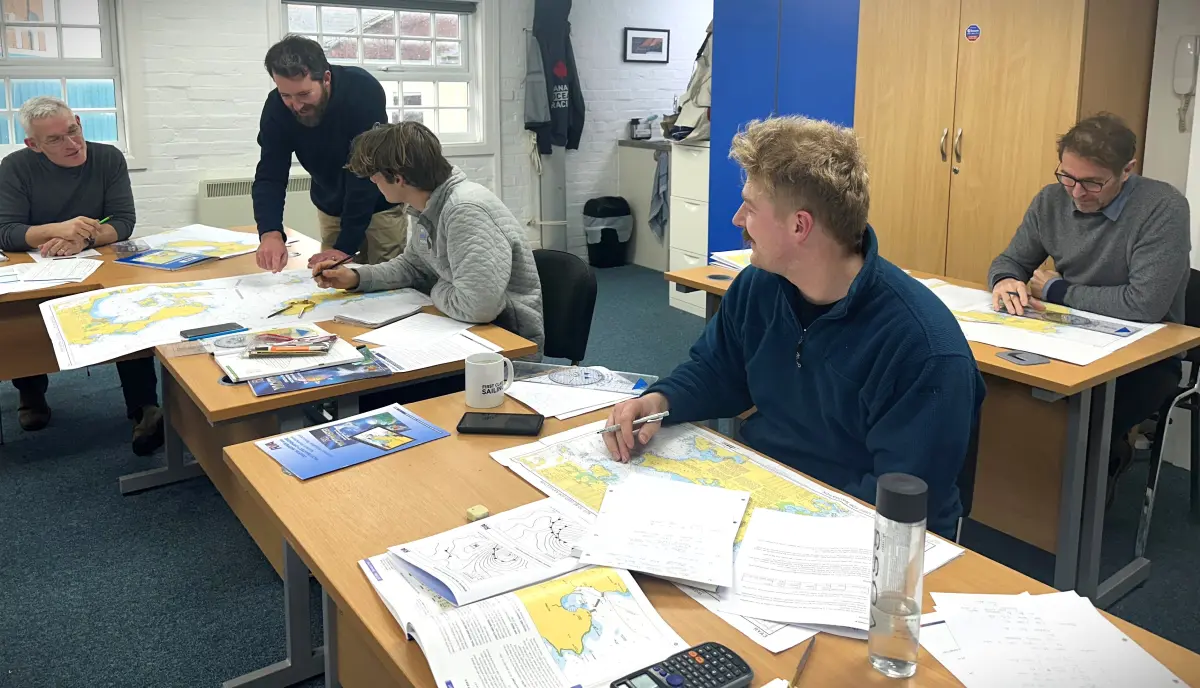
This is why many sailors favour classroom navigation courses. Live instruction allows chartwork techniques to be demonstrated, questioned and refined in real time, building confidence as well as competence.
First Class Sailing delivers classroom RYA Day Skipper Theory courses, RYA Yachtmaster Theory (Coastal Skipper / Offshore), and RYA Yachtmaster Ocean Theory in Southampton and at London venues, as well as in-office evening classes for organisations:
-
RYA Day Skipper Theory classroom courses in Southampton and London
https://www.firstclasssailing.com/rya-courses/day-skipper-theory-course -
RYA Yachtmaster Theory (Coastal Skipper / Yachtmaster Offshore) classroom courses
https://www.firstclasssailing.com/rya-courses/yachtmaster-theory-course -
RYA Yachtmaster Ocean Theory classroom courses
https://www.firstclasssailing.com/rya-courses/yachtmaster-ocean-theory-course
For those who need flexibility, online Day Skipper Theory and online Yachtmaster Theory are also available via training partner, providing an alternative route into practical sailing or classroom progression.
Where the wider learning debate often concludes is that format should match complexity. Introductory and flexible study suits online delivery; advanced, judgement-heavy subjects benefit from classroom teaching. In navigation training—particularly at Yachtmaster and Ocean level—that distinction becomes especially clear.
Classroom vs online navigation courses: the real difference
Both classroom and online courses cover the whole syllabus for each course and lead to the same shore based qualification. The difference is how learning happens:
Classroom navigation courses
Classroom learning is structured and instructor-led, which tends to work best when:
-
A mistake needs correcting immediately (before it becomes a habit)
-
A technique is easier to “see done” (tidal vectors, secondary port calculations, passage planning)
-
Understanding matters more than memorising (especially at Yachtmaster level)
Online navigation courses
Online courses suit learners who value flexibility and self-pacing. First Class Sailing offers online theory via partner Skippers Online for Day Skipper and Yachtmaster Theory.
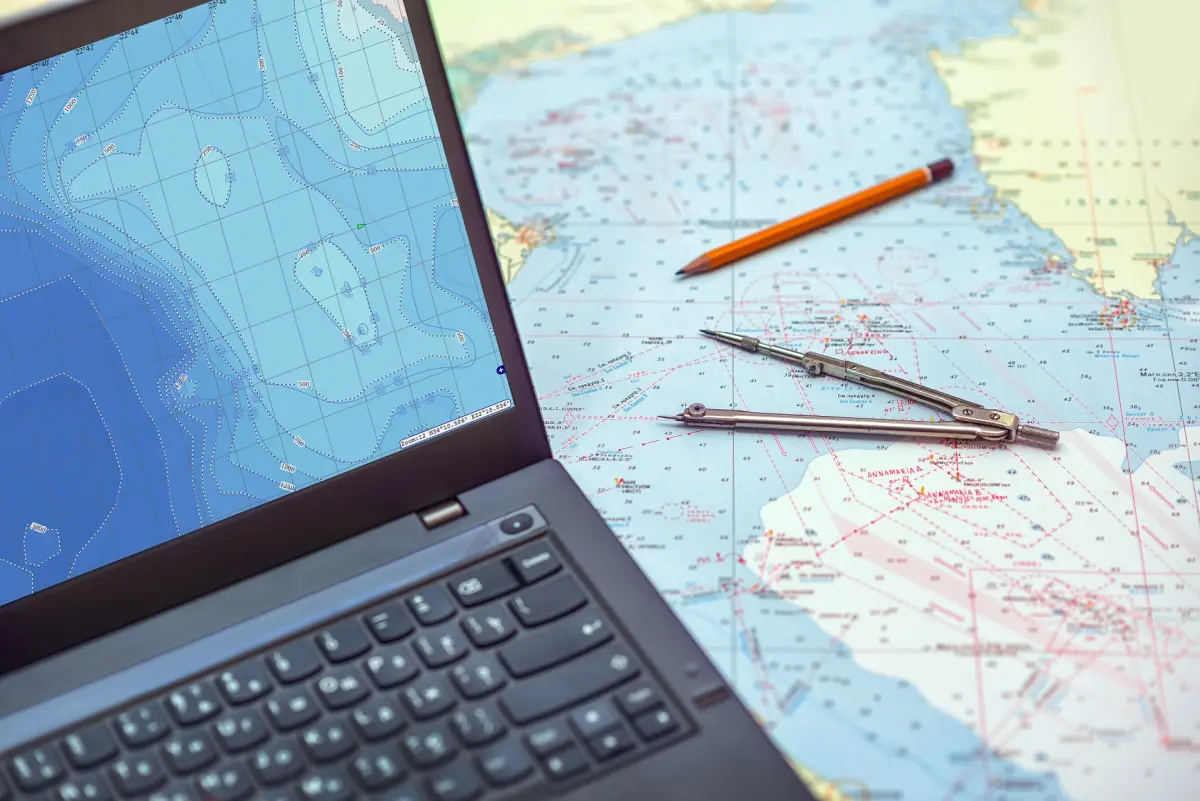
Online navigation course for RYA Day Skipper and Yachtmaster Theory study
RYA Day Skipper Theory: classroom vs online
The RYA Day Skipper Theory course is where many sailors first combine chartwork, tides, weather and rules of the road into real decision-making. First Class Sailing’s classroom course runs in different formats (often evenings + weekend, weekends, or consecutive days).
Why classroom Day Skipper Theory often feels easier
Classroom Day Skipper Theory tends to be more efficient for beginners because:
-
Chartwork errors are spotted and fixed immediately
-
Subjects like course to steer and tides can be worked through step-by-step with instant understanding feedback from the instructor
-
COLREGs can be taught through real scenarios (not just revision-style learning)
For schedules and options, see RYA Day Skipper Theory course in Southampton or London.
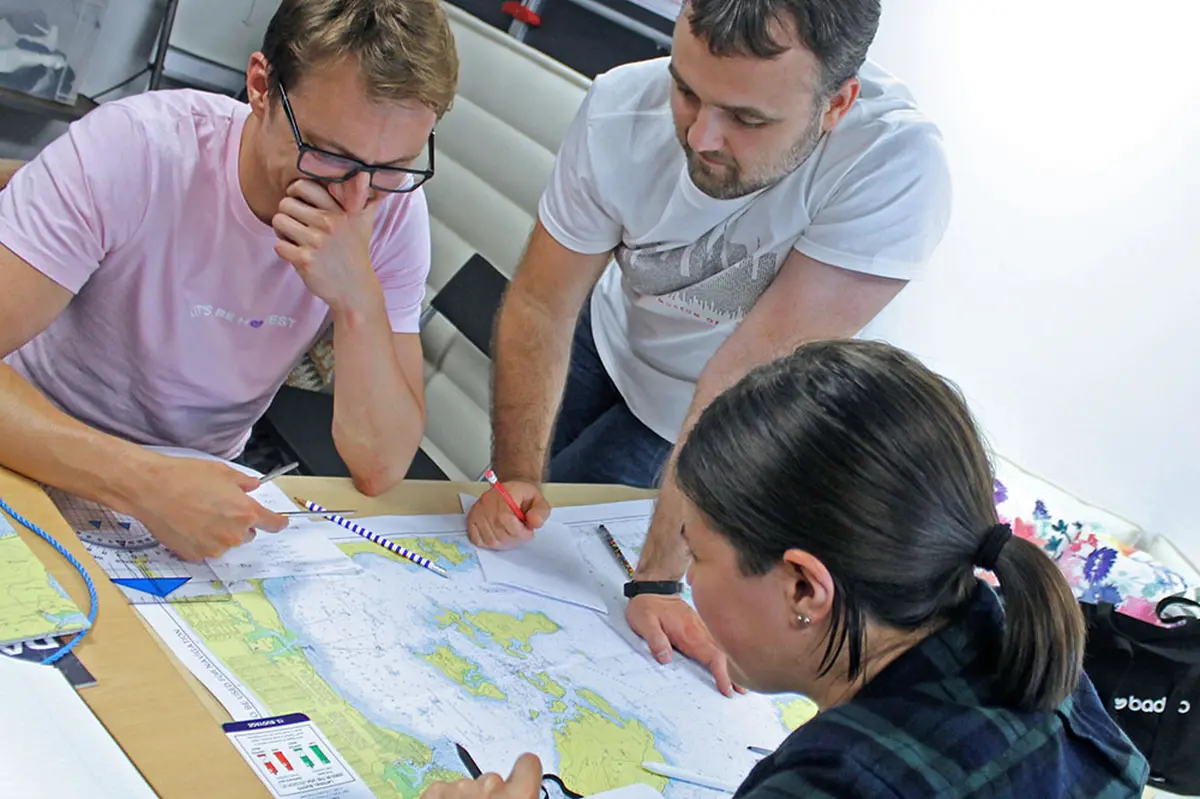
RYA Day Skipper Theory classroom navigation course with chartwork and tidal calculations
When online Day Skipper Theory makes sense
Online Day Skipper is a strong fit when flexibility around timings and location matters most. You can dip in and out of the course as suits, wherever you are in the world.
See Online RYA Day Skipper Theory course.
RYA Coastal Skipper / Yachtmaster Offshore Theory: classroom vs online
RYA Yachtmaster Theory (also known as Coastal Skipper / Yachtmaster Offshore shorebased) is the step up from Day Skipper and goes deeper into offshore/coastal navigation, pilotage, passage planning and meteorology.
Why classroom Yachtmaster Theory is often the better choice
At this level, classroom learning tends to win because:
-
Misunderstandings get corrected early (before they cascade across longer problems)
-
Instructors can challenge why a decision is made, not just whether the answer is right
-
Group discussion improves judgement as well as technique
See RYA Yachtmaster Theory course in Southampton or London.
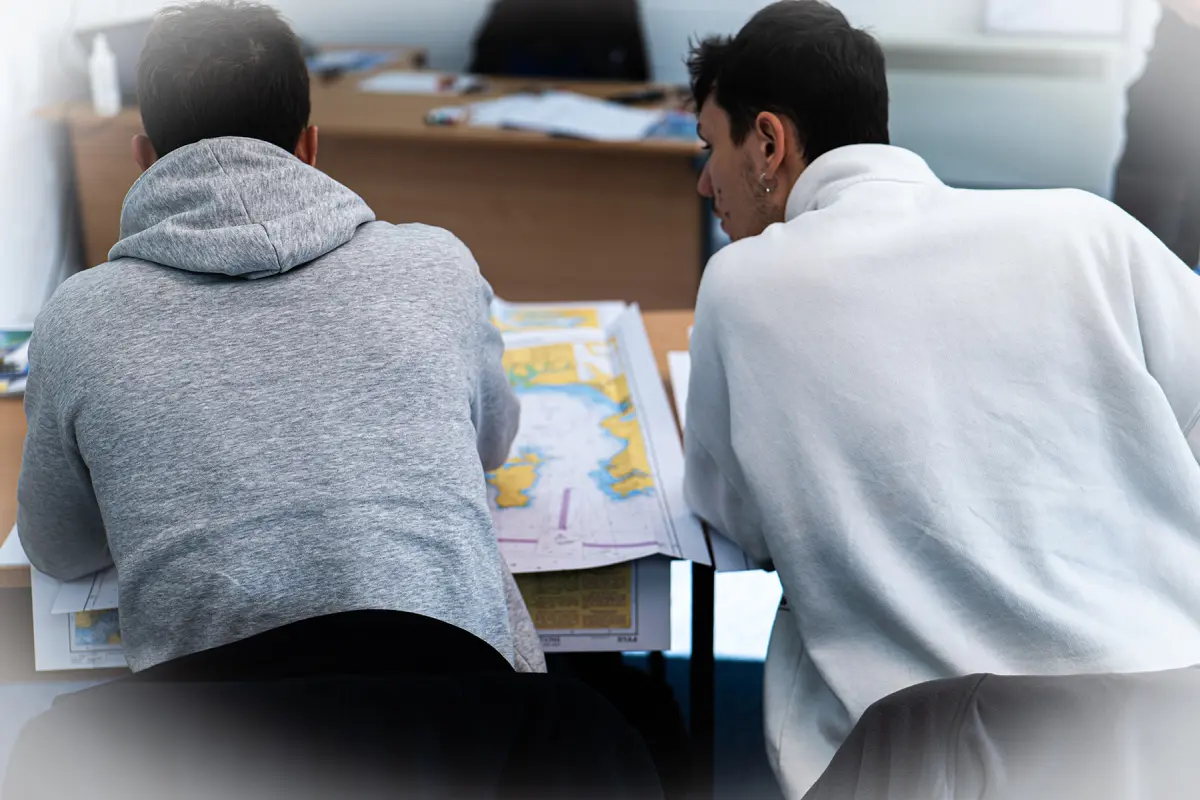
RYA Yachtmaster Theory classroom course for Coastal Skipper and offshore navigation
Online Yachtmaster Theory: who it suits best
Online Yachtmaster Theory works well for confident self-learners who can keep momentum without fixed evenings. Like the online Day Skipper course this option is great if a regular location and time are difficult to stick to.
See Online RYA Yachtmaster Theory course.
Yachtmaster Ocean Theory: the strongest case for classroom learning
RYA Yachtmaster Ocean Theory covers astro-navigation (including sextant work) and worldwide meteorology, and assumes prior shorebased knowledge to Yachtmaster Theory level.
This is the course where classroom delivery typically pays off most, because the material is dense and unfamiliar, and live worked examples plus immediate correction and explanation from a helpful friendly instructor can save a lot of time and head scratching.
First Class Sailing runs it in Southampton and London: RYA Yachtmaster Ocean Theory course.

RYA Yachtmaster Ocean Theory classroom course with celestial navigation training
Southampton, London and in-office navigation courses
Classroom courses are delivered in our classrooms at Shamrock Quay in Southampton and at various London venues (including Knightsbridge and Limehouse).
For organisations, First Class Sailing also runs training at a client’s workplace (often as evening classes), removing commuting while keeping the classroom benefits: For more details have a look at Sailing courses in your office.
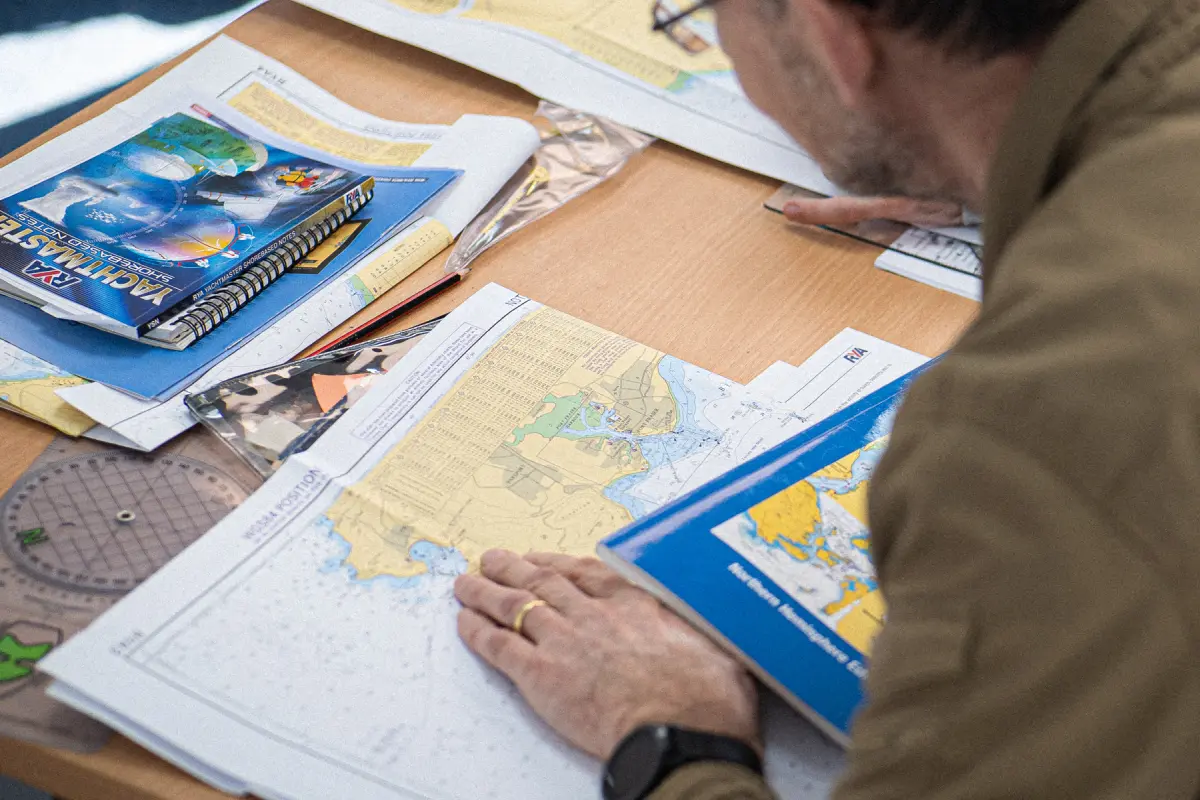
Classroom navigation courses in Southampton London and in-office RYA theory training
Image placement (in-office section): evening class in a boardroom/meeting room
Alt text: Classroom navigation courses in Southampton London and in-office RYA theory training
FAQs: classroom vs online navigation courses
What is the main difference between classroom and online learning?
Classroom learning is instructor-led and interactive, offering immediate feedback and discussion. Online learning is self-paced and flexible, relying more on independent study and self-motivation.
Are classroom courses better for complex subjects?
Classroom courses are often more effective for complex or technical subjects because instructors can identify misunderstandings early and adapt explanations in real time.
Is RYA Day Skipper Theory better done online or in the classroom?
Both formats work well. Classroom learning is often preferred by those new to navigation, particularly for chartwork and tidal calculations. Online learning suits those who need flexibility and are comfortable studying independently.
Can RYA Yachtmaster Theory be studied online?
Yes. Online Yachtmaster Theory is available and suits experienced sailors who already have a strong navigation background. Many candidates choose classroom learning due to the complexity of passage planning and offshore navigation topics.
Why do sailors often prefer classroom courses for Yachtmaster Theory?
Classroom courses allow instructors to challenge decision-making, demonstrate methods live, and correct errors early, which helps build confidence and exam readiness.
Is there an online option for Yachtmaster Ocean Theory?
Online options exist elsewhere, but many sailors prefer classroom learning due to the technical and unfamiliar nature of celestial navigation and worldwide meteorology.
Why is Yachtmaster Ocean Theory particularly suited to classroom learning?
Ocean Theory introduces complex concepts that build on each other. Classroom teaching allows step-by-step explanation, live worked examples, and immediate clarification.
Where are First Class Sailing’s classroom navigation courses run?
Courses are run in Southampton and at various London venues, with formats including evening, weekend and intensive courses.
Can navigation theory courses be delivered in a company’s office?
Yes. First Class Sailing delivers in-office RYA theory courses, commonly as evening classes for organisations.