Last updated: 4 March 2026
People working towards RYA Yachtmaster Coastal or RYA Yachtmaster Offshore often ask a simple question: is the Mediterranean tidal, and do Mediterranean miles count as tidal miles?
Prerequisites for the Yachtmaster Coastal and Yachtmaster Offshore exams include a required amount of tidal experience. At least half the prerequisites must be in tidal waters. This means candidates must have completed at least 400 nautical miles for Yachtmaster Coastal and 1,250 nautical miles for Yachtmaster Offshore in tidal waters.
If most sailing experience has been gained in UK waters, then those miles are automatically considered tidal. But what happens if a large proportion of sailing has taken place in the Mediterranean?
Does the Mediterranean Sea Have Tides?
Yes, the Mediterranean Sea does have tides. However, they are very small compared with tidal ranges in the Atlantic Ocean or around the UK.
In most parts of the Mediterranean the tidal range is only 20–40 centimetres. Because the tidal influence is so small, Mediterranean sailing is usually considered non-tidal for the purposes of RYA Yachtmaster exam prerequisites.
How the RYA Defines Tidal Waters
The RYA definition of tidal waters is important when considering whether sailing miles count as tidal experience.
The RYA states:
“An area is deemed tidal if published stream, current or tidal range data is available, the influence of which is significant enough to require the effects to be taken into account to plan and execute a safe and efficient passage.”
A fuller explanation of this definition can be found in our guide to what is considered tidal water for a Yachtmaster qualification.
The RYA also provides guidance on qualifying passages and experience requirements in its qualifying passages guidance.
Around the UK these tidal effects are substantial. Passage planning often requires careful calculation of tidal streams, secondary ports and tidal gates.
In the Mediterranean, however, the tidal influence is usually so small that it rarely affects navigation in the same way. As a result, Mediterranean sailing miles are normally considered non-tidal when counting experience towards Yachtmaster qualifications.
Why Mediterranean Miles Are Usually Considered Non-Tidal
The Mediterranean is a semi-enclosed sea connected to the Atlantic Ocean through the Strait of Gibraltar.
Because this connection is relatively narrow, tidal energy from the Atlantic cannot move freely into the Mediterranean basin. This limits the tidal range throughout much of the sea.
Across most of the Mediterranean the tidal range is around 30 centimetres, which is why tidal calculations rarely influence day-to-day navigation.
For people building experience towards Yachtmaster Coastal or Yachtmaster Offshore, this means Mediterranean miles are valuable for gaining offshore experience, but they usually do not count as tidal miles.
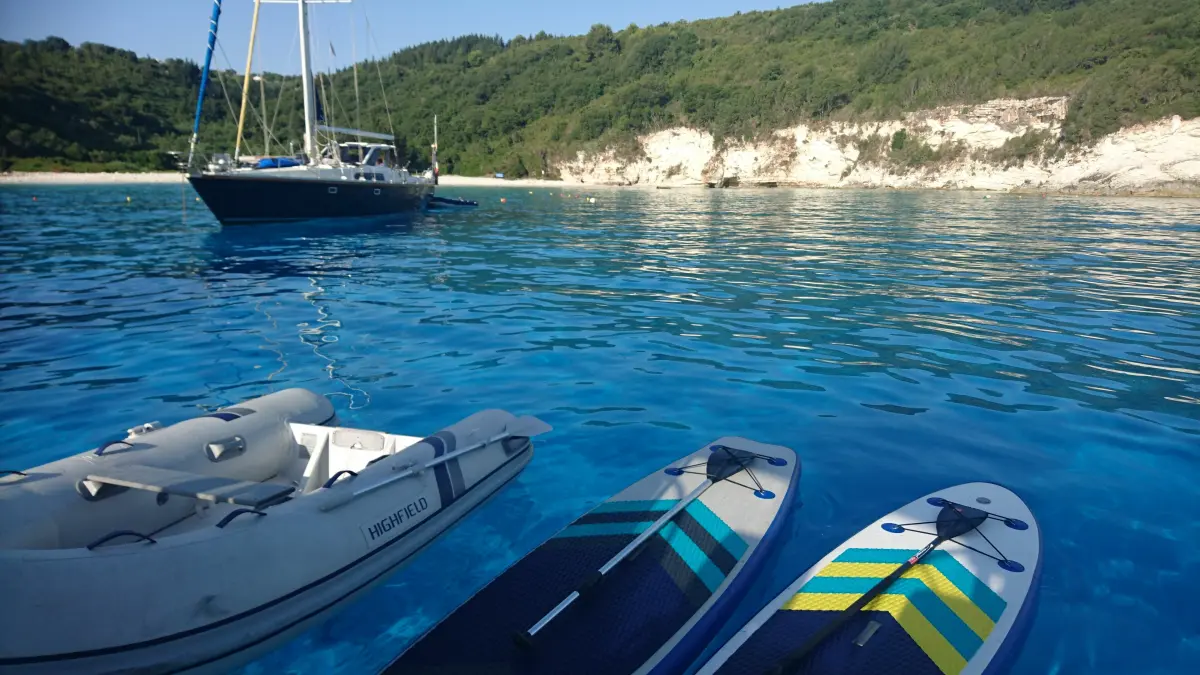
Mediterranean sailing conditions where tidal range is typically very small
Mediterranean Tides: How Big Are They?
What tide there is in the Mediterranean are primarily diurnal, meaning there is typically one high tide and one low tide each day.
This contrasts with many areas around the UK. The Solent, for example, experiences semi-diurnal tides with two highs and two lows each day, as well as complex tidal behaviour such as double high waters.
The Solent also has a large tidal range and strong tidal streams. This makes it an excellent place to gain tidal experience while learning boat handling, navigation and passage planning.
Where the Mediterranean Has Larger Tides
Although tidal ranges are generally small, there are some locations where tidal movement becomes more noticeable.
Examples include:
-
the Gulf of Gabès in Tunisia
-
parts of the northern Adriatic Sea
Local geography in these areas can amplify tidal movement slightly. Even so, the tidal ranges remain small compared with those found along Atlantic coastlines.
The Role of the Strait of Gibraltar
The Strait of Gibraltar plays an important role in the tidal dynamics of the Mediterranean.
This narrow channel — only about 8.5 miles wide at its narrowest point — is the only natural connection between the Mediterranean Sea and the Atlantic Ocean.
Because the opening is relatively small, tidal energy from the Atlantic cannot fully propagate into the Mediterranean basin. This significantly reduces the tidal range across most of the sea.
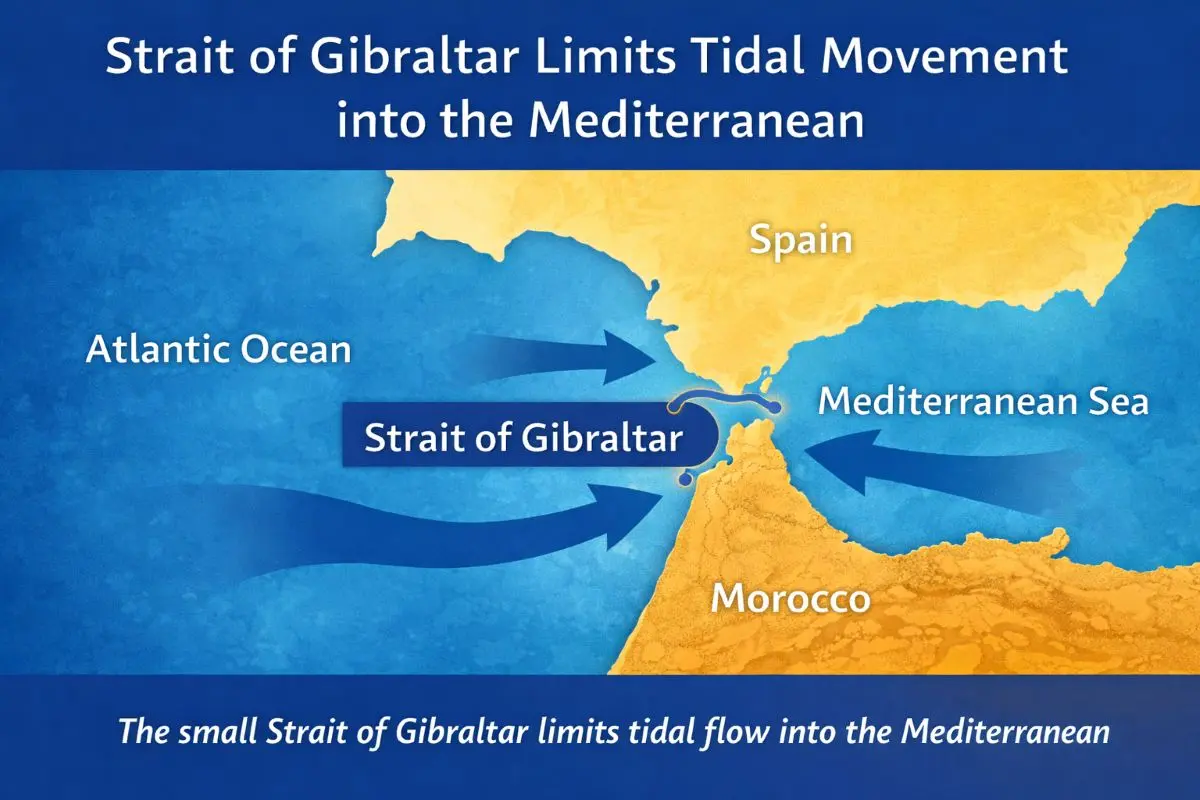
Map showing how the Strait of Gibraltar limits tidal movement into the Mediterranean
Mediterranean Tides Compared With UK Waters
The difference between Mediterranean tides and UK tides is dramatic.
Around the UK, tidal ranges commonly reach 4–8 metres, particularly in areas such as the English Channel and Bristol Channel.
By contrast, much of the Mediterranean experiences tidal ranges of only 20–40 centimetres.
This is why tidal planning is essential when sailing in UK waters but far less important when cruising most Mediterranean coastlines.
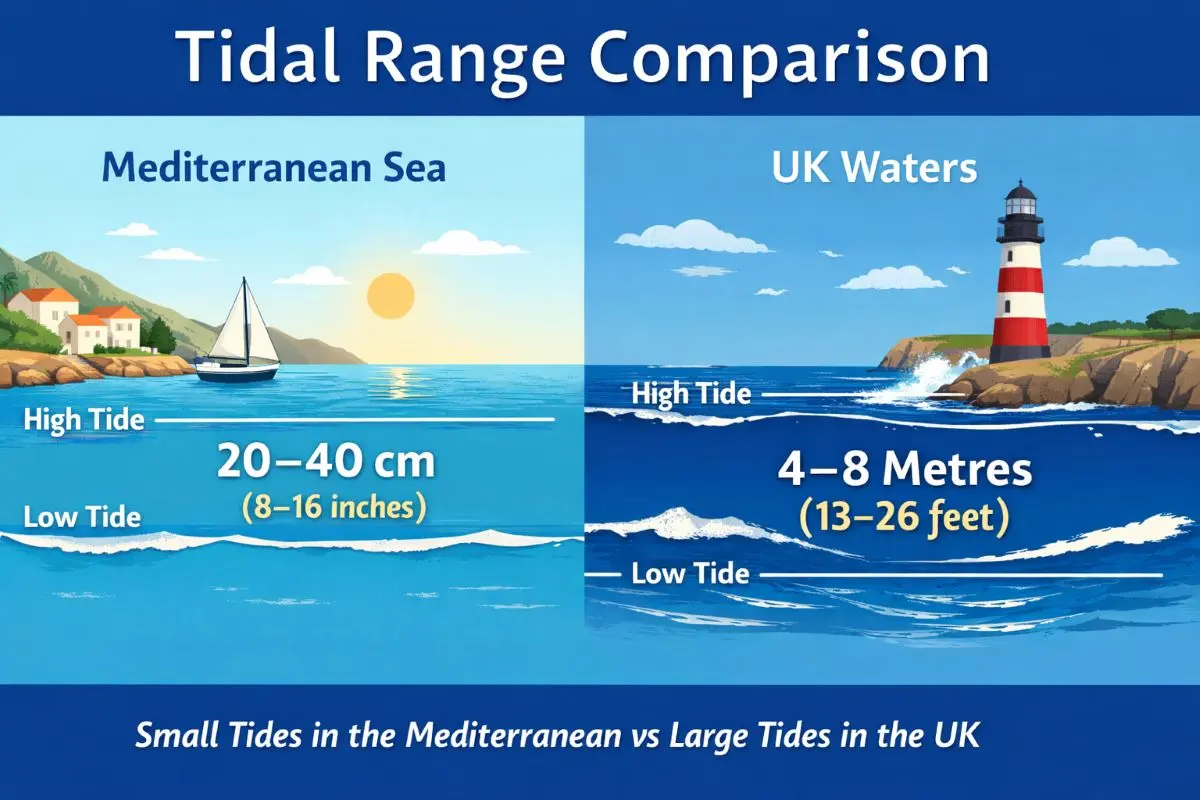
Comparison of tidal range between the Mediterranean Sea and UK waters
Other Factors That Affect Sea Level
Tides are not the only factor affecting sea level.
Atmospheric pressure also influences water levels. A high-pressure weather system lowers sea level, while low pressure raises it.
In the Mediterranean these pressure effects can sometimes produce changes in sea level that are larger than the normal tidal range.
Do You Need Tidal Calculations When Sailing in the Mediterranean?
In most parts of the Mediterranean, tidal calculations rarely play a major role in passage planning. Harbours, anchorages and coastal passages are generally planned without needing to calculate tidal heights or tidal streams in the same way that is common in the UK.
Instead, Mediterranean navigation tends to focus more on factors such as weather patterns, local winds and harbour approaches. Seasonal winds like the Mistral, Meltemi and Bora often have a much greater impact on passage planning than tides.
However, this difference is one reason why people preparing for Yachtmaster Coastal or Yachtmaster Offshore often build experience in tidal waters as well. Areas such as the Solent and the English Channel provide valuable opportunities to practise tidal navigation, including interpreting tidal streams and planning passages around tidal gates.
Building Tidal Miles for Yachtmaster Qualifications
People working towards Yachtmaster Coastal or Yachtmaster Offshore sometimes discover that much of their sailing experience has taken place in non-tidal waters such as the Mediterranean.
When preparing for the exam, it is important to gain experience in areas where tidal streams and tidal heights influence navigation decisions.
This is why many candidates choose to build additional experience in the Solent and English Channel, where tidal conditions provide excellent opportunities to practise passage planning, tidal calculations and navigation in moving water.
A practical way to gain this experience is through structured sailing weekends and mile building sailing trips, which are designed to combine offshore passage making with tidal navigation.
Examples include:
-
longer offshore passages such as Norway sailing adventures
-
major offshore passages such as Atlantic crossings
These trips allow participants to build offshore miles while gaining the tidal experience required for Yachtmaster exams.
For those preparing for the qualifications themselves, more details about the training routes can be found on the Yachtmaster Coastal course and Yachtmaster Offshore course pages.
Mediterranean Tides – Quick Facts
Does the Mediterranean Sea have tides?
Yes, but they are very small compared with tidal ranges in the Atlantic or around the UK.
Is the Mediterranean considered tidal?
Technically yes. However, the tidal influence is usually too small to affect navigation significantly.
What is the tidal range in the Mediterranean?
In most places the tidal range is around 20–40 cm, although a few areas such as the Gulf of Gabès experience slightly larger tides.
Do Mediterranean miles count as tidal miles for Yachtmaster exams?
Generally no. Because tidal influence is small, Mediterranean miles are normally considered non-tidal when counting experience towards Yachtmaster Coastal or Yachtmaster Offshore.