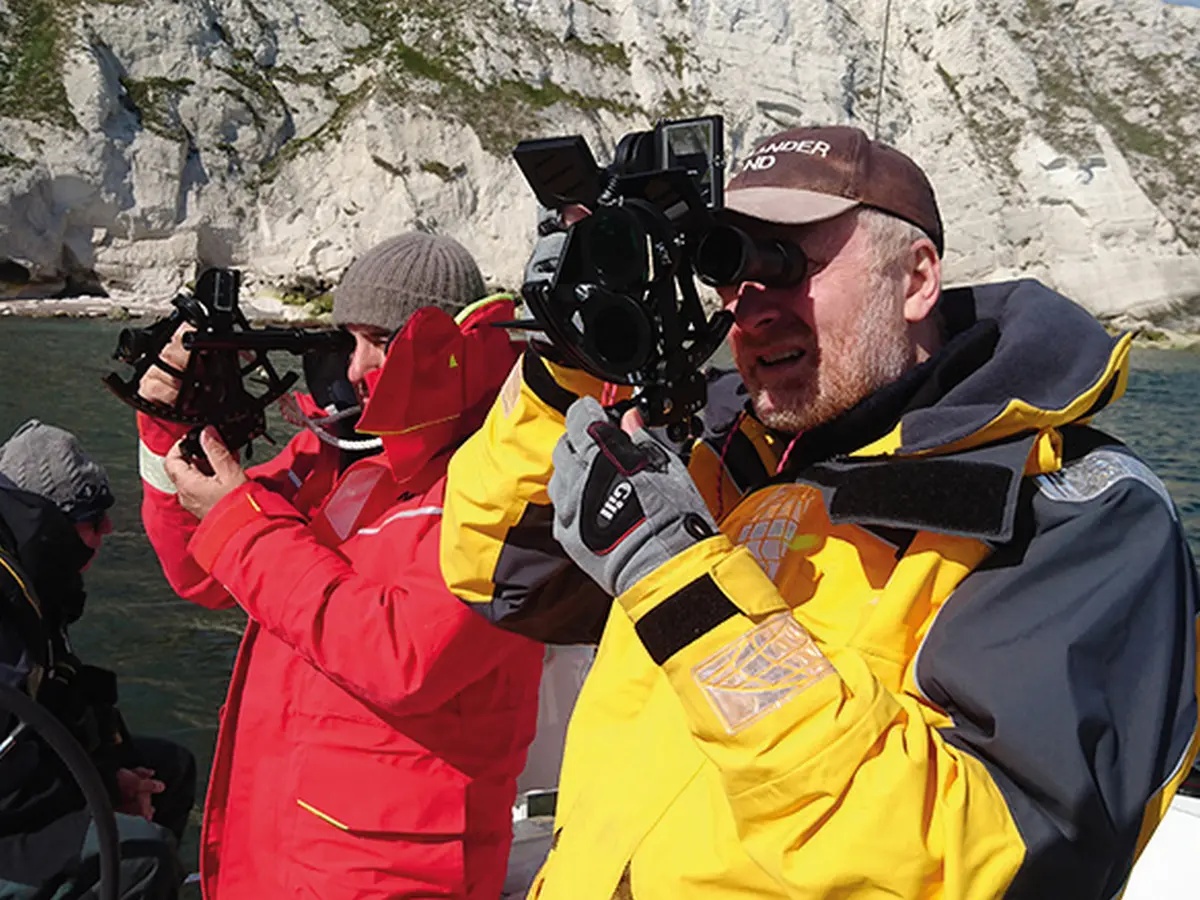
A Guest Article from the Hallberg-Rassy Owners Association
From time to time, sailors who train or cruise with First Class Sailing also contribute thoughtful writing to owner associations and sailing groups, sharing practical experience and reflections that go beyond logbooks and course notes.
The following article was written by Geoffrey Farmiloe for the Hallberg-Rassy Owners Association, an active community of Hallberg-Rassy owners who share technical knowledge, cruising experience, and seamanship insights. It is reproduced here with kind permission and presented in full, exactly as originally written.
Much of what is discussed in the article closely reflects the skills developed on RYA Yachtmaster Ocean Theory courses, where subjects such as ocean passage planning, ocean meteorology, and celestial navigation are covered in depth. The next classroom course runs 16–20 March at Shamrock Quay in Southampton, followed immediately by one of the celestial navigation sailing weekends (21–22 March), where sextant work and sight reduction are practised at sea rather than only in the classroom.
Together, ocean theory courses and practical celestial weekends form a natural progression for sailors preparing for longer offshore passages, ocean crossings, or simply wanting to understand the traditional skills that still underpin modern offshore navigation.
When you hang up your Yacht Racing Cap and reach for a Sextant
Lots of us have done it, as a young lad or lass jumping around on the foredeck and gybing spinnakers. Then progressive with age or time there is that gradual move to the back of the boat. Less hauling on halyards, more helming or if you are lucky, forming something of the stern guard, the owner and their cherished inner circle.
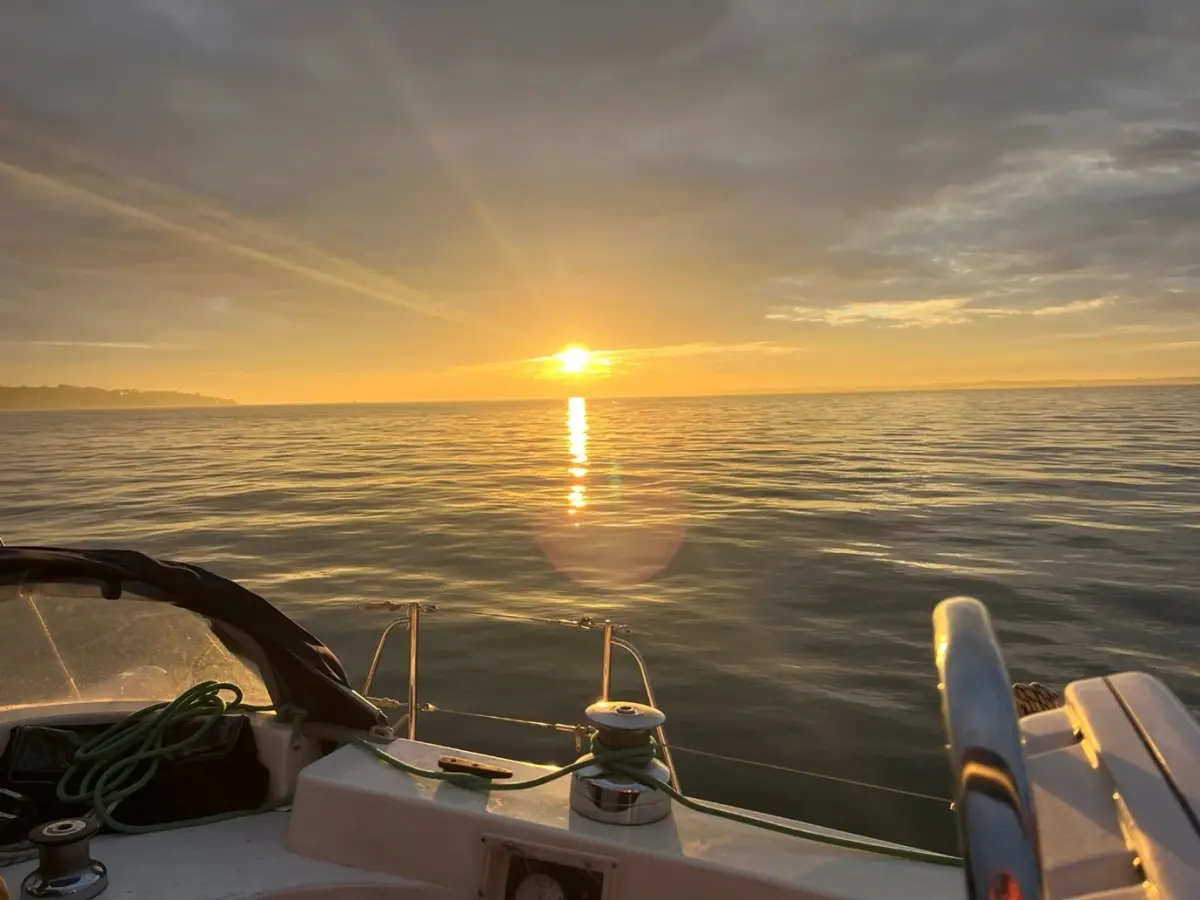
Horizon at dawn
So, what next? I did my Yachtmaster Ocean in 1995 and thirty years on, I have forgotten almost everything I learnt by way of celestial navigation. I tried digging out my old study notes, but it was a struggle with dimming memory and a more sedate learning style. I did, however, want to re-learn that old and ancient skill, so I went back to school, navigation school. I chose First Class Sailing[1] in Southampton as my guiding light and they proved to be outstanding. There are more than a few good RYA establishments teaching Astro Navigation, but this was my preferred option given that I have used them in the past and they have always been very supportive, with high standards.
To my great fortune and eternal gratitude, my instructor was Nigel Rennie[2]. A highly professional navigator with the patience of Job and a plethora of teaching aids to encourage dull students or at least so in my case, to learn and remember the intricacies of celestial navigation. Five days or 4 ½ days to be precise, (the last afternoon is taken up with an examination), is not a long time to learn the subtleties of Stars, Sun-Run-Sun, Polaris and Planet sights and the plotting of the same. Still, I’d done it before 30 years ago so no real problem, right? Wrong, I found it tough and with three hours homework a night and an 8.30am start, I felt the calling of a racing foredeck much more appealing.
So, persevere I must do and work through the nightly sight data and equations. I’m not sure what was really driving me to this goal but many years ago whilst sailing across Biscay with a doctor best known for astro dependency, he introduced me to articles in Practical Boat Owner[3] entitled ‘Astro Navigation now it’s child’s play’… it’s not! This expounded the virtues of an old Casio FX-730P computer, I use the term advisedly because it only had 8KB of memory that could be extended to 16KB with additional RAM and code which was written in BASIC. Now with my reborn novice astro skills I wanted to replicate another lost art. An hour later and with the loss of £30 on e-bay I was the proud owner of a second-hand masterpiece.[4]
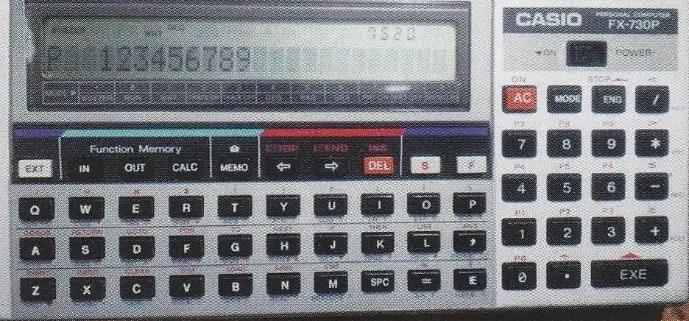
Old Casio Calculator used in sight reduction calculations
I spent several days programming it, reprogramming it and re-learning BASIC computer language, finally I was there, I had done it, and it worked! Then my wife pointed out to me that for the price of a data cable, about the same price as a coffee in the city, I could have downloaded all the programmes in about an hour. I didn’t want to hear that and so I went back to the chart table.
You might be thinking that the use of a calculator, however ancient, defeated the object of using a sextant. After all, the objective was to circumvent the possibility of ‘electricity and saltwater making green gung’ and to really navigate by the stars. Well, that is true to an extent, but this was rather like finding those Commando comic books left in the loft many years ago and I sat there reminiscing. I was hooked but first I had to consolidate my astro skills within the classroom and my daily routine, with the aid of Nigel Rennie who took us through the differing nuances of Stars, Planet, Polaris and the Sun. There were also other subjects like global weather and Tropical Revolving Storms to be crammed into this 4 ½ day window.
Well Friday dawned and as the morning rolled on, I started to think what on earth possessed me to be taking further examinations at my age. There were four other students and although I didn’t need to take the exam, I felt the need to support my fellow sufferers, (I mean students). As it ended, we all passed somehow and then the hard work seemed to pale into insignificance, as a few beers dulled the mind once more. Was it worth it? Most definitely and I now have that astro skill reborn in me. Although, how the likes of Robin Knox-Johnson or Éric Tabarly navigated around the globe single handed with just a sextant is beyond me. It is very important to look after your sextant and mine stays by me alongside the fireplace, except on the odd occasion that I take it out to sea.
Geoffrey’s sextant
I have re-learnt a thing long forgotten and now I intend to use it more frequently and stow it carefully in our treasured Rassy – PEGASUS. I commend you not to lose that skill or let it dull to the point of obsolescence but be proud of the art hard fought to possess.
The time has come, with antifouling done, the winches serviced, and the engine cleaned and oiled. Now it is my time to unlock the sextant (did I tell you I have bought a new one, but don’t tell Rosemary) and I think of far-flung places. I did think of Plymouth sailing down to Rio de Janeiro to follow the Clipper Race but one should not be too hasty. Maybe sun sights off the beach in Wembury first, before anchoring off Jennycliff to practice star sights at twilight. I want to pace myself you see, not to over stretch things.
I recognise that there are many people on various Hallberg Rassy yachts who know a great deal more about celestial navigation than I do. I am merely encouraging skippers and crew to dust off their own sextant, get out there and try a little more. Ocean sailing with empty horizons has that mystifying romanticism that can never be calmed by the reality of a Force 8 on the nose.
Fair winds and pleasant seas.
[1]https://www.firstclasssailing.com/?gad_source=1&gclid=Cj0KCQiA4fi7BhC5ARIsAEV1YibVSatCeI_B4cWu5PKgPw57yG-aVNatgxTsiAUFpJDwpbXNcUaFdUAaAoDWEALw_wcB
[2] https://www.scribd.com/document/770568327/Astro-Forms-N-Rennie-2020c
[3] Practical Boat Owner 259 JUNE 1988
[4] Anyone wishing for the details of the computer programme then please e-mail me.
With Thanks to Geoffrey Farmiloe and the HROA
Sincere thanks go to Geoffrey Farmiloe and to the Hallberg-Rassy Owners Association for allowing this article to be shared with a wider sailing audience.
Accounts like this echo many of the questions and learning moments that arise on ocean theory courses and offshore sailing weekends — particularly when sailors begin to connect chartwork, astronomical theory, and real-world navigation decisions made at sea.
For those building towards longer offshore passages or formal qualifications, combining RYA Yachtmaster Ocean Theory training with time on the water using both traditional and electronic navigation methods provides a strong foundation for future adventures, whether that leads to transocean cruising, ocean racing, or extended offshore mile-building.
Further details of upcoming ocean theory courses, celestial navigation weekends, and offshore sailing opportunities are available across the First Class Sailing website.
To deepen your understanding of the traditional skills Geoffrey discusses, many sailors find our article “Celestial Navigation Is an Ancient Sailing Skill You Need to Know” a useful companion, as it explains the history, purpose, and practical value of navigating by the stars and sun. For those thinking about how ocean passage planning and offshore qualifications fit together, our guide on the difference between Yachtmaster Ocean and Yachtmaster Offshore offers a clear breakdown of the syllabus, prerequisites, and real-world applications of each certificate — helping to clarify the role that theory and practical experience play in developing confident offshore competence.
Further details of upcoming ocean theory courses, celestial navigation weekends, and offshore sailing opportunities are available across the First Class Sailing website.
Yachtmaster Ocean Navigation – FAQs
What is covered in a Yachtmaster Ocean Theory course?
RYA Yachtmaster Ocean Theory courses cover ocean passage planning, worldwide meteorology, ocean currents, great circle sailing, and celestial navigation using the sun, stars, planets, and moon.
Is celestial navigation still relevant with modern GPS?
Yes. While GPS is the primary navigation system on most yachts, celestial navigation remains part of the Yachtmaster Ocean syllabus and provides an independent backup method as well as a deeper understanding of ocean navigation principles. It is also a lot of fun and very satisfying!
Do the celestial sailing weekends involve using a sextant at sea?
Yes. Celestial sailing weekends are designed to practise taking sights on deck, recording observations, and completing full sight reductions and position lines while underway.
Is ocean theory required before doing practical ocean sailing?
Ocean theory is not legally required, but it is strongly recommended for anyone planning offshore passages, ocean races, or transocean cruising, and it is required for candidates taking the Yachtmaster Ocean oral exam.
{
"@context": "https://schema.org",
"@graph": [
{
"@type": "Article",
"@id": "https://www.firstclasssailing.com/blog/yachtmaster-ocean-navigation-a-sailors-celestial-experience/#article",
"headline": "Yachtmaster Ocean Navigation: A Sailor’s Celestial Experience",
"description": "A guest article by Hallberg-Rassy owner Geoffrey Farmiloe reflecting on rediscovering celestial navigation, ocean theory, and navigating by the stars.",
"image": {
"@type": "ImageObject",
"url": "https://www.firstclasssailing.com/blog/wp-content/uploads/2026/01/sextant-at-sea.jpg",
"width": 1200,
"height": 800
},
"author": {
"@type": "Person",
"name": "Geoffrey Farmiloe",
"url": "https://www.hroa.co.uk/"
},
"publisher": {
"@id": "https://www.firstclasssailing.com/#organization"
},
"mainEntityOfPage": {
"@type": "WebPage",
"@id": "https://www.firstclasssailing.com/blog/yachtmaster-ocean-navigation-a-sailors-celestial-experience/"
},
"datePublished": "2026-01-16T09:00:00+00:00",
"dateModified": "2026-01-16T09:00:00+00:00",
"about": [
{ "@type": "Thing", "name": "Celestial navigation" },
{ "@type": "Thing", "name": "RYA Yachtmaster Ocean" }
],
"isPartOf": {
"@type": "Blog",
"@id": "https://www.firstclasssailing.com/blog/#blog"
}
},
{
"@type": "FAQPage",
"@id": "https://www.firstclasssailing.com/blog/yachtmaster-ocean-navigation-a-sailors-celestial-experience/#faq",
"mainEntity": [
{
"@type": "Question",
"name": "What is covered in a Yachtmaster Ocean Theory course?",
"acceptedAnswer": {
"@type": "Answer",
"text": "RYA Yachtmaster Ocean Theory courses cover ocean passage planning, worldwide meteorology, ocean currents, great circle sailing, and celestial navigation using the sun, stars, planets, and moon."
}
},
{
"@type": "Question",
"name": "Is celestial navigation still relevant with modern GPS?",
"acceptedAnswer": {
"@type": "Answer",
"text": "Yes. While GPS is the primary navigation system on most yachts, celestial navigation remains part of the Yachtmaster Ocean syllabus and provides an independent backup method as well as a deeper understanding of ocean navigation principles."
}
},
{
"@type": "Question",
"name": "Do the celestial sailing weekends involve using a sextant at sea?",
"acceptedAnswer": {
"@type": "Answer",
"text": "Yes. Celestial sailing weekends are designed to practise taking sights on deck, recording observations, and completing full sight reductions and position lines while underway."
}
},
{
"@type": "Question",
"name": "Is ocean theory required before doing practical ocean sailing?",
"acceptedAnswer": {
"@type": "Answer",
"text": "Ocean theory is not legally required, but it is strongly recommended for anyone planning offshore passages, ocean races, or transocean cruising, and it is required for candidates taking the Yachtmaster Ocean oral exam."
}
}
]
}
]
}